


Catalogue note
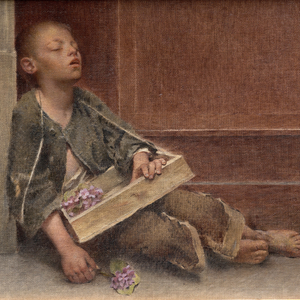
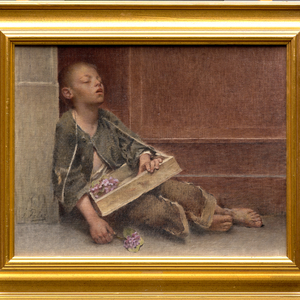
At the Paris Salon of 1885, Fernand Pelez exhibited one of his most poignant depictions of childhood poverty. He called it Un martyr- Le Marchand de violettes (Paris, Petit Palais). Our painting is a smaller version, and like the Salon entry, shows a young street urchin in tattered clothing with dusty feet. He sleeps against a doorway (most likely the setting was the entrance to Pelez’s studio at 62 Boulevard de Clichy), his body still weighted down by his heavy tray, now with only two bouquets left to sell.
Fernand Pelez, more than any other artist of his generation, documented the “misère” of the impoverished inhabitants of Paris, especially the children. “Martyrized children were Pelez’s specialty; in fact, one painting representing an impoverished street child was titled A Martyr: The Violet Seller when it appeared in the Salon of 1885. In this painting, the delicacy of the skin tones, the veil of dirt over the feet, the exhaustion implied by the open-mouthed face of the sleeping child, are set forth against a backdrop of almost abstract rectangular planes, playing against the tilt of the crude wooden tray dangling from the exhausted boy’s neck.” (Linda Nochlin, Misère: The Visual Representation of Misery in the 19th Century, London, 2018, p. 139).
In Pelez’s violet seller, we see the secular reality of the young boy’s life – his exhaustion, his dirty garments, his shoeless feet. But please do not forget, Pelez called him a martyr, something sacred, not secular. The luminosity and the soft glow of his face tilted upward, are perhaps a hint of better things to come, or deliverance from the inevitable circumstances of his young life.