


 fig. 1


Provenance
Thomas Barlow Walker, Minneapolis, 1889 (acquired directly from the artist for 1,500 frs)
Walker Art Gallery, Minneapolis, 1927 (donated by the above)
The Walker Art Center, Minneapolis, 1940 (and sale, Parke-Bernet Galleries Inc., New York, June 3-4, 1971, lot 38)
Forbes Magazine Collection, New York
Sale, Sotheby’s, New York, February 25, 1982, lot 77
Kurt E. Schon Ltd., New Orleans, 1984
Sale, Christie’s, New York, 18 October 2000, lot 45
European Art Gallery, Dallas, Texas (acquired at the above)
Stephanie and Michael Seay, Dallas, Texas (acquired from the above)
Exhibited
Paris, Salon, 1889, no. 796.
Literature
W. Armstrong, “Current Art: The Salon,” Magazine of Art, 1889, vol. XII, pp. 417–18 (illustrated).
“Le Salon de 1889. La peinture,” L’Illustration, no. 2409, 27 April 1889, p. 334.
“Salon de 1889,” L’Art, revue hebdomadaire illustrée, January 1889, p. 218.
G. Lafenestre, Le Salon de 1889, Paris, Jean Boussod, Manzi, Joyant et Cie, 1889, pp. 56–57 (illustrated).
A. Wolff, “Le Salon de 1889,” Figaro-Salon, Paris, J. Boussod, Manzi, Joyant et Cie, 1889, p. 39.
F. Jaryer, “Le Salon de 1889,” L’Entracte, 14 mai 1889, n.p.
E. Junca, “La peinture au Salon, III,” La Civilisation, journal quotidien, 16 May 1889, no. 119, n.p.
L. Bacon, “A Painter of Motherhood. Virginie Demont-Breton,” The Century Magazine 53, November 1896, p. 210.
C. M. White, “A Western Art Collection,” Brush and Pencil, vol. 4, no. 4, July 1899, p. 184 (illustrated p. 190).
R. H. Adams, T. B. Walker Art Gallery, Minneapolis, Minnesota: Alphabetical List of Artists, 1927, no. 90, p. 52 (illustrated).
J. B. de la Faille, The Complete Letters of Vincent van Gogh: His Paintings and Drawings, Amsterdam, 1970, pp. 256–57, no. F644.
P. Lecaldano, L’Opera completa di Van Gogh, vol. II, Milan, Rizzoli Editore, 1971, pp. 221–22, no. 705a (illustrated).
E. Bénézit, Dictionnaire critique et documentaire des peintres, sculpteurs, dessinateurs et graveurs, Paris, Librairie Grund, 1976, vol. III, p. 489.
A. Bourrut Lacouture, “Virginie Demont-Breton (1859–1935), peintre de Wissant: la famille, la mer et les mythes fin de siècle, 1ère partie,” BONONIA, Revue de l’Association des Amis des Musées de Boulogne-sur-Mer, no. 19, 2e semestre 1991, p. 40 (illustrated p. 39).
J. Whitmore, “Presentation Strategies in the American Gilded Age: One Case Study,” in Nineteenth-Century Art Worldwide 3, no. 2, Autumn 2004, http://www.19thc-artworldwide.org/autumn04/presentation-strategies-in-the-american-gilded-age-one-case-study
Catalogue note
In a rustic and unadorned interior, a mother sits holding her sleeping child. The scene is lit by the glow of the hearth, its flickering, warm-toned light modelling the woman’s face and the rough surfaces of the interior. Her weary, melancholic gaze is fixed on the fire as she waits for her husband at sea. Set in the coastal village of Wissant, where Demont-Breton spent most of her summers, the painting evokes the difficult conditions of fishing communities and the precarious existence of a fisherman’s wife.
With her broad posture and protective aura, the figure appears both monumental and intimate. The mother’s expression conveys the anxious reality of her situation. Through this unembellished realism, Demont-Breton raises her above her difficult life and presents her as a modern-day Madonna. The child sleeping on her lap has been suggested to be the artist’s own daughter, which may explain why, as one critic observed, “the artist who knew the sacredness of a mother’s love painted into the picture much of the intensity of that love.”[1]
Motherhood occupies a central place in Demont-Breton’s oeuvre, and mothers are portrayed as women of flesh and blood, powerful, dignified, and unembellished. As one critic wrote, “her mothers speak to all and her children to those who have had children of their own. They are not impossible, idealized dream-children and dream-mothers, but real ones such as one knows.”[2] Painted in her characteristic academic naturalist style and on a grand scale, L’homme est en mer is a powerful example of Demont-Breton’s depictions of motherhood.
When L’homme est en mer was exhibited at the Salon of 1889, it met with immediate acclaim. In her agenda, Élodie Breton, Virginie’s mother, recorded the enthusiastic reception at the Salon preview: “Great success for Virginie with her painting, The Man at Sea […] the entire jury applauded, shouting ‘bravo!’ We are very happy.”[3]. The American artist Alexis Fournier described it as “one of the greatest pictures in the country, and has been talked about on both sides of the water.”[4] The Parisian critic M. Seymour de Ricci called it “one of the finest paintings of modern times,”[5] while another reviewer ranked it as “one of the few naturalistic Madonna’s which will bear comparison in nobility of conception with the great Italian paintings of the fifteenth century.”[6]
On the varnishing day of the Salon of 1889, the American collector, Thomas Barlow Walker saw the canvas just after it was installed. He immediately approached Demont-Breton, who promised to sell him the picture. This sale added greatly to her reputation overseas, where she could command even higher prices than in France.
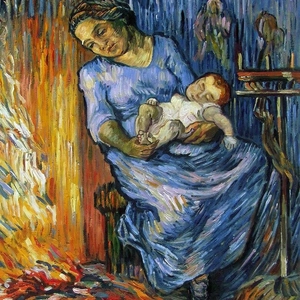
Shortly after the Salon, the magazine Le Monde illustré published an engraving of L’homme est en mer. This reproduction reached Vincent van Gogh, who wrote to his brother that the magazine contained a “very pretty engraving after Demont-Breton”.[7] Van Gogh had already met Demont-Breton, probably in 1875, according to a letter to his brother Theo: “I recently saw Jules Breton with his wife and two daughters.”[8] Van Gogh probably mistook Virginie’s cousin Julie, with whom she grew up, for a daughter of Breton. By the time he saw the engraving, Van Gogh was in a psychiatric institution in Saint-Rémy-de-Provence, where he copied many prints of famous paintings. Although he followed the compositions of the black-and-white prints closely, he reimagined their colors and added impasto, entirely in his own style. A month later, he informed Theo that he had “copied that woman with a child sitting beside a hearth by Mrs Demont-Breton, almost all violet.”[9]
(fig. 1) Vincent Van Gogh, L'homme est en Mer, 1889, Private Collection.
This note was written by Merel Rotman
[1] R. H. Adams, The Walker Art Galleries: Alphabetical List of Artists with Biographical Sketches, The Walker Art Galleries, 1927, p.52.
[2] Lee Bacon, “A Painter of Motherhood. Virginie Demont-Breton,” in The Century Magazine 53, November 1896, p.210.
[3] Cited in A. Bourrut Lacouture, “Virginie Demont-Breton (1859-1935), Peintre de Wissant : La Famille, la Mer et les Mythes fin de siècles, 1ère Partie,” in BONONIA, Revue de l’Association des Amis des Musées de Boulogne s/mer, n°19, 2ème Semestre 1991, p. 40.
[4] Clara M. White, “A Western Art Collection,” in Brush and Pencil 4, no. 4, July 1899, p.184.
[5] R. H. Adams, The Walker Art Galleries: Alphabetical List of Artists with Biographical Sketches, The Walker Art Galleries, 1927, p.52.
[6] Ibid.
[7] Letter 800. Vincent van Gogh to Theo van Gogh. Saint-Rémy-de-Provence, 5 and 6 September 1889.
[8] Letter 34. Vincent van Gogh to Theo van Gogh. Paris, 31 May 1875.
[9] Letter 810. Vincent van Gogh to Theo van Gogh. Saint-Rémy-de-Provence, 8 October 1889.